-
An outdoor ceiling fan can be one of the most practical additions to a patio, porch, pergola, or covered outdoor living room. Unlike air conditioning, a fan doesn’t actually lower the outdoor air temperature. Instead, moving air across your skin can make the space feel more comfortable—exactly what you want on a warm summer afternoon.
But outdoor fans aren’t one-size-fits-all.
A small covered porch has very different needs than a 500-square-foot outdoor kitchen. A coastal home needs to consider moisture and corrosion, while a large suburban patio may prioritize airflow and coverage. Even the amount of protection provided by your roof matters when selecting a fan.
Before choosing one based on looks alone, here’s what homeowners should consider.
Start With One Important Question: Where Is the Fan Going?
The location of your fan should drive almost every other decision.
Start by looking at the size of your outdoor area, ceiling height, exposure to weather, and how you use the space.
For example, a fan installed beneath a fully covered porch may never experience direct rain. A fan beneath an open-sided pergola, on the other hand, could be exposed to wind-driven rain and significant moisture.
That distinction matters because indoor and outdoor ceiling fans aren’t interchangeable.
When shopping, pay particular attention to whether a fan is rated for damp or wet locations.
Damp-Rated vs. Wet-Rated Outdoor Fans
This is arguably the most important specification to understand.
Damp-Rated Fans
Damp-rated fans are intended for locations that experience humidity and moisture but are protected from direct water exposure.
They can work well in areas such as:
- Covered porches
- Screened-in patios
- Deep covered decks
- Finished under-deck living areas
- Fully covered outdoor kitchens
Wet-Rated Fans
Wet-rated fans are designed for locations where water may come into direct contact with the equipment. Wet locations are those where water or other liquids may drip, splash, or flow against electrical equipment.
These are worth considering for:
- Pergolas with partial roof coverage
- Gazebos
- Open-air patios
- Coastal outdoor spaces
- Areas exposed to wind-driven rain
When in doubt, choosing a wet-rated fan can provide greater flexibility for outdoor placement. Always verify that the specific fan is listed for the environment where you intend to install it.
Choosing the Right Fan Size
Bigger isn’t automatically better, but outdoor spaces often benefit from larger fans because there’s no enclosed room to contain the airflow.
Ceiling fan size is typically described by blade span, or the diameter from one side of the fan to the other.
You’ll commonly encounter outdoor fans around:
- 44–52 inches: smaller porches and compact patios
- 52–60 inches: typical residential covered patios
- 60–72 inches: larger outdoor living rooms
- 72+ inches: oversized patios, outdoor kitchens, and expansive covered spaces
Don’t treat those numbers as strict sizing rules. Ceiling height, layout, fan performance, mounting position, and manufacturer recommendations all matter.
ENERGY STAR’s certified-fan database includes models ranging from compact fans to 84-inch designs, illustrating just how much variation is available.
For a long rectangular patio, two moderately sized fans may provide better coverage than one enormous fan positioned in the center.
Think about where people actually sit rather than simply centering the fan on the ceiling.
Look at Airflow, Not Just Blade Size
Two 60-inch fans won’t necessarily perform the same.
That’s where CFM—cubic feet per minute— becomes useful. CFM describes the amount of air a fan moves. You may also see CFM per watt, which measures airflow efficiency.
ENERGY STAR uses CFM/W as part of its efficiency criteria and establishes minimum airflow requirements for certified ceiling fans.
When comparing fans of similar sizes, look at:
Airflow (CFM): How much air the fan moves.
Efficiency (CFM/W): How effectively it produces airflow relative to its energy consumption.
Speed settings: Greater control can make the fan useful during both mild and extremely hot weather.
Don’t assume the fan with the longest blades automatically produces the best airflow. Motor and blade design matter too.
Best Fan for a Typical Suburban Covered Patio
For a conventional suburban home with a covered deck or patio, simplicity is often best.
A 52- to 60-inch outdoor-rated ceiling fan can be a good starting point for many moderate-sized spaces, subject to the fan manufacturer’s sizing guidance. If the patio is larger or divided into dining and seating areas, consider installing two fans.
Look for:
- Multiple speeds
- Remote or wall control
- An integrated LED light if overhead lighting is limited
- A finish that complements exterior fixtures
- Damp or wet rating appropriate for the location
A black, bronze, or natural-looking fan can blend into a traditional outdoor space without becoming the main design feature.
Best Fan for a Large Luxury Outdoor Living Space
Large outdoor rooms require a different approach.
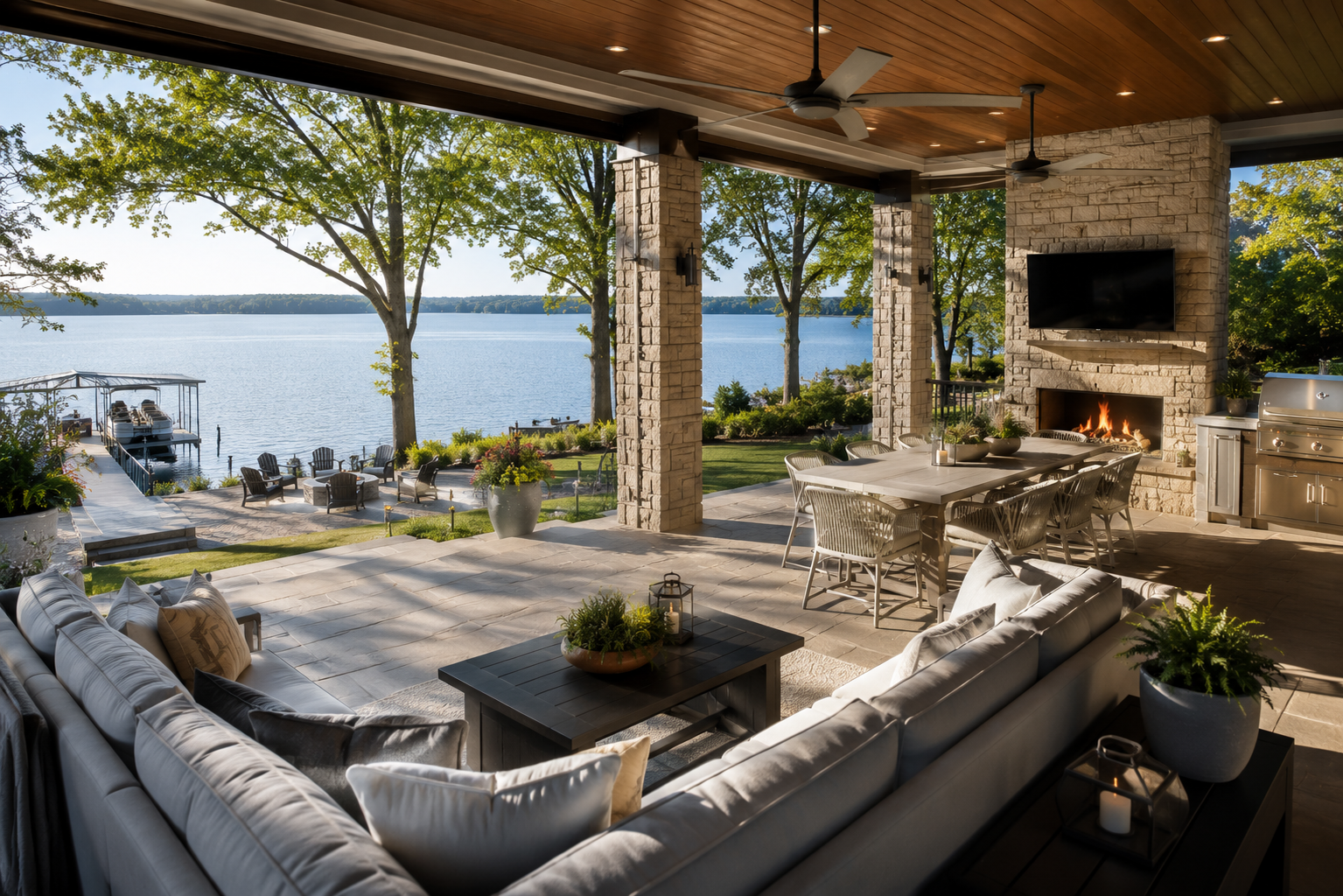
If your patio includes a kitchen, dining table, sectional, fireplace, and television, one standard fan may leave significant dead zones.
Consider large-diameter fans or multiple coordinated fans positioned above the primary gathering areas.
For example, one fan might serve the dining area while another provides airflow above the lounge.
Larger high-efficiency models can provide substantial airflow without necessarily requiring proportionally more energy. ENERGY STAR-certified models are evaluated for airflow and efficiency, making those metrics useful when comparing premium options.
For a modern luxury space, minimalist three-blade designs and fans with concealed motors can integrate especially well with contemporary architecture.
Best Fan for a Finished Under-Deck Space
A finished space beneath an elevated deck is a natural location for an outdoor ceiling fan.
Because these spaces are typically covered, a damp-rated fan may be appropriate if the installation location is fully protected from direct water exposure. If wind-driven rain or other direct moisture is possible, look for an appropriate wet-rated option instead.
Ceiling height is particularly important.
If the finished under-deck ceiling is relatively low, consider a hugger or low-profile fan. ENERGY STAR defines a hugger fan as one where the lowest point of the blades sits 10 inches or less from the ceiling.
This can preserve headroom while still introducing airflow.
Pair the fan with recessed lighting, outdoor speakers, comfortable furniture, and a television, and an under-deck area can begin to function much more like an outdoor living room.
Best Fan for a Pergola
Pergolas can be tricky because weather exposure varies dramatically.
A solid-roof pergola may provide substantial protection. An open-slat pergola provides much less.
If there’s a realistic chance of rain reaching the fan, choose a fan specifically rated for wet locations.
Also consider how the fan will mount. Pergolas may have exposed beams, sloped structures, or unusually high ceilings requiring specialized mounting hardware or downrods.
This is an area where planning before purchasing can prevent a frustrating installation later.
Best Fan for Coastal or Humid Homes
If you live near the coast or in an especially humid climate, pay extra attention to construction materials.
Moisture and salt air can be hard on exterior equipment.
Look for outdoor-rated fans specifically designed for demanding environments and consider corrosion-resistant finishes, durable blade materials, and sealed components appropriate for the installation environment.
A beautiful indoor-style fan isn’t a bargain if its materials deteriorate quickly outdoors.
AC vs. DC Motor Fans
You’ll increasingly see outdoor fans marketed with DC motors.
Modern DC-motor fans are often attractive because they can provide efficient operation, quiet performance, and numerous speed settings. That can be particularly useful in outdoor living areas where the fan may operate for hours at a time.
ENERGY STAR notes that certified fans use improved motors and blade designs and reports that qualifying models can be considerably more efficient than conventional models.
Efficiency matters most when you’re installing multiple fans or expect them to run frequently throughout the summer.
Should You Get a Fan With a Light?
This depends entirely on your outdoor lighting plan.
For a simple covered porch, a fan with an integrated LED can solve two problems at once.
For a more sophisticated outdoor living room, separate lighting is often more flexible. Recessed lights, sconces, pendants, and accent lighting can create layers of illumination without requiring the ceiling fan to act as the room’s primary light source.
If you already have a good outdoor lighting plan, a fan without a light can also create a cleaner appearance.
Don’t Forget Smart Controls
Outdoor fans are becoming increasingly connected. ENERGY STAR’s current product database includes models with Wi-Fi and Bluetooth connectivity alongside conventional models.
Depending on the fan, smart features may allow you to:
- Adjust fan speed from your phone
- Create operating schedules
- Control integrated lighting
- Use voice commands
- Coordinate the fan with other smart-home devices
Are smart controls necessary? No.
But if you’re already incorporating smart lighting, outdoor audio, motorized shades, or other connected features, they can make an outdoor room easier to control.
The Outleven Outdoor Fan Buying Checklist
Before purchasing, ask:
- Is the fan rated for my level of weather exposure?
- Do I need damp-rated or wet-rated equipment?
- How large is my patio?
- Would one large fan or two smaller fans provide better coverage?
- What is the fan’s CFM?
- How efficient is it in CFM/W?
- Is my ceiling high enough for the mounting configuration?
- Do I need a low-profile model?
- Do I want an integrated light?
- Do I want wall, remote, or smart controls?
- Are the materials suitable for my climate?
- Does the design complement the rest of my outdoor space?
Choose a Fan for the Space You Actually Have
The best outdoor fan isn’t necessarily the biggest, most expensive, or most technologically advanced model.
It’s the one that fits your particular outdoor environment.
A small suburban porch may need one simple 52-inch fan. A sprawling covered patio could benefit from two or three larger fans. A coastal pergola may prioritize weather resistance above everything else, while a finished under-deck room might require a low-profile design to preserve headroom.
Start with the location. Determine the proper weather rating. Then consider size, airflow, efficiency, controls, and appearance.
When those elements work together, a ceiling fan stops feeling like an appliance hanging above your patio.
It becomes part of the outdoor room.
Sources
- ENERGY STAR — Ceiling Fan Buying & Efficiency Guidance
- ENERGY STAR — Ceiling Fan Key Product Criteria
- ENERGY STAR — Certified Ceiling Fan Database
- U.S. Department of Energy — Ceiling Fans
- UL Solutions — Environmental Location Markings
Outdoor Heaters 101: A Beginner’s Guide to Choosing the Right Heating Solution for Your Outdoor Space
This beginner’s guide breaks down the most common outdoor heating options, including propane, electric infrared, and natural gas heaters. Learn how each type works, where it performs best, and what to consider when planning for your patio, deck, or outdoor living space.