Audio Source
Music may come from a streaming service, phone, television, media player, receiver, or whole-home audio platform.

Learn how to plan outdoor audio that delivers clear, balanced sound across patios, decks, pools, gardens, and covered outdoor living spaces. Compare speaker types, placement, wiring, amplifiers, subwoofers, wireless audio, and weather-resistant equipment.
An outdoor sound system is a group of speakers, amplification, wiring or wireless connections, and controls designed to reproduce music and other audio in exterior living spaces. Systems can range from a pair of weather-resistant patio speakers to distributed landscape audio with multiple speakers and outdoor subwoofers positioned throughout a backyard. The best system depends on the size and shape of the listening area, speaker placement, desired volume, weather exposure, amplification, wiring, neighboring properties, and how the outdoor space is used.
Outdoor audio is more than choosing speakers. A complete system connects the audio source, amplification, speakers, wiring or network connection, and controls into one coordinated system.
Music may come from a streaming service, phone, television, media player, receiver, or whole-home audio platform.
An amplifier or receiver supplies the power needed to drive passive outdoor speakers and may also provide source selection and zone control.
Speakers convert the audio signal into sound and should be selected and positioned around the listening areas they need to cover.
Volume controls, apps, remotes, zones, and smart-home integrations determine how easily the system can be operated from outside.
Learn how outdoor audio works, compare speaker types, plan speaker placement, and understand wiring, amplification, weather resistance, and system controls.
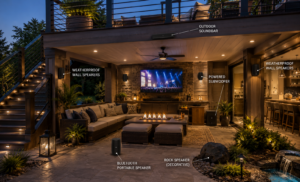
Outdoor speakers are built for tougher environments, but routine care can help keep your system performing its best. Learn how to clean speakers, inspect wiring and connections, care for landscape and portable speakers, and identify changes in sound that could indicate a problem.
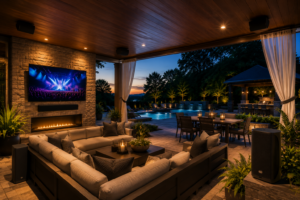
The right outdoor sound system can elevate everything from quiet evenings on the patio to lively backyard gatherings. This guide compares Bluetooth speakers and whole-home audio systems, breaking down the pros, cons, costs, and best use cases to help you choose the perfect setup for your outdoor living space.
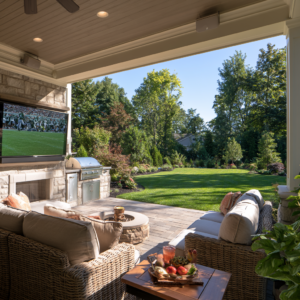
A quality outdoor sound system can transform your backyard into the perfect space for relaxing, entertaining, or enjoying your favorite music and podcasts. This beginner’s guide covers the different types of outdoor speakers, key features to consider, and practical tips for choosing the right audio setup for your outdoor living space.
Speaker type should follow the layout of the outdoor space. A covered patio, open lawn, pool area, and large landscaped backyard often require very different approaches to distributing sound.
Traditional outdoor speakers can mount to walls, columns, beams, or other suitable structures and direct sound toward a defined listening area.
Landscape systems distribute multiple speakers closer to listeners throughout gardens, lawns, pools, and larger outdoor entertainment areas.
Portable Bluetooth or network-connected speakers can provide a simpler option when permanent wiring and installed speakers are not necessary.
A common outdoor audio mistake is trying to cover a large backyard with one or two speakers played loudly. Sound levels fall as listeners move farther from the speakers, which can create an uneven experience.
In larger outdoor spaces, distributing speakers closer to the listening areas can create more consistent sound while allowing each speaker to operate at a more comfortable level.
Explore outdoor speaker questions“Wireless audio” can describe several different systems. A system may stream music wirelessly from a phone or network while still using speaker wire between the amplifier and the outdoor speakers.
Passive outdoor speakers connect by speaker wire to an amplifier or receiver, creating a permanent system that can serve one or multiple outdoor listening zones.
Wiring is easiest to plan before walls, ceilings, landscaping, or other finished surfaces make cable routing more difficult.
Network-based audio can make source selection, multi-room playback, grouping, and app control more convenient.
The music signal may be wireless even when the speakers themselves still receive power or audio through physical wiring.
Portable Bluetooth speakers offer a simple way to add music without installing a permanent system and can work well for smaller listening areas.
Battery life, charging, range, weather exposure, output, and the need to move or store the speaker should be considered.
Installed outdoor audio depends on the equipment behind the speakers as much as the speakers themselves. Amplification, wiring, bass, streaming, and zone control all influence how the finished system performs.
Amplification should be matched to the speaker system, number of channels or zones, system design, and the requirements of the equipment being used.
A subwoofer handles low-frequency sound and can add depth to larger outdoor audio systems without asking smaller speakers to reproduce all of the bass.
Permanent systems need cable appropriate for the installation environment and a routing plan that protects wiring while keeping future service in mind.
Separate zones can allow a covered patio, pool, lawn, or other areas to operate at different volume levels or, depending on the system, play different sources.
Outdoor speakers and audio components should be selected for the conditions where they will actually be installed. Equipment under a protected patio can experience very different exposure from speakers installed in landscaping or near a pool. Moisture, precipitation, irrigation, temperature changes, sunlight, dust, and corrosion can all affect outdoor equipment.
Follow the equipment manufacturer's installation requirements and use mounting hardware, wiring, connections, and electrical components appropriate for the location. Amplifiers and other electronics should only be installed in environments for which they are designed.
Outdoor audio is easier to integrate when speakers, wiring, power, lighting, fans, heaters, and finished surfaces are planned together. A covered patio, for example, may need speaker wire, lighting circuits, fan wiring, heater circuits, television connections, and network coverage routed through many of the same structural areas.
Coordinating these systems before ceilings, walls, decking, or landscaping are complete can reduce visible wiring and help equipment locations work together rather than compete for the same space.
Quick answers to common questions about outdoor speakers, placement, wiring, wireless audio, amplifiers, subwoofers, weather resistance, and backyard sound systems.
Start with where people listen, then choose speaker types, placement, amplification, wiring, bass, streaming, and controls around the layout of your patio or backyard.