-
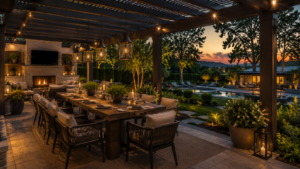
Outdoor lighting can completely change the way a home looks and functions after sunset. A few carefully placed fixtures can make stairs safer, illuminate a pathway, highlight landscaping, or transform a basic patio into a comfortable outdoor living room.
But buying outdoor lighting can quickly become confusing. Path lights, spotlights, deck lights, solar fixtures, low-voltage systems, smart controls, lumens, color temperatures, and weather ratings all compete for attention.
The key is to choose lighting based on what you want it to accomplish, rather than simply buying fixtures you like.
This outdoor lighting buying guide covers the most important things homeowners should consider before purchasing a system.
Start With the Purpose of Your Lighting
Before looking at individual products, walk through your outdoor space and identify where light would actually be useful.
Most residential outdoor lighting falls into three general categories:
Safety and functional lighting helps illuminate stairs, pathways, entrances, cooking areas, and elevation changes.
Accent lighting highlights landscaping and architectural features such as mature trees, stone walls, gardens, columns, or water features.
Ambient and entertainment lighting creates atmosphere around decks, patios, pergolas, dining spaces, and outdoor living rooms.
The best designs typically combine all three rather than relying on one fixture type.
DarkSky International and the Illuminating Engineering Society recommend that outdoor lighting have a clear purpose, be directed only where needed, remain no brighter than necessary, use controls when possible, and favor warmer-colored light.
Know the Main Types of Outdoor Lights
Once you know where lighting is needed, you can start matching fixtures to each application.
Path Lights
Path lights create small pools of illumination along walkways, driveways, gardens, and entrances. They’re useful for both safety and landscaping.
Avoid placing them in perfectly straight, tightly spaced rows unless that’s intentionally part of the design. More subtle spacing often creates a softer appearance.
Spotlights and Uplights
These fixtures direct concentrated beams toward specific features.
Positioning a spotlight beneath a mature tree, stone façade, column, or architectural detail can add significant depth to a property after dark.
The beam angle matters: narrow beams create dramatic accents, while wider beams illuminate larger surfaces.
Deck and Step Lights
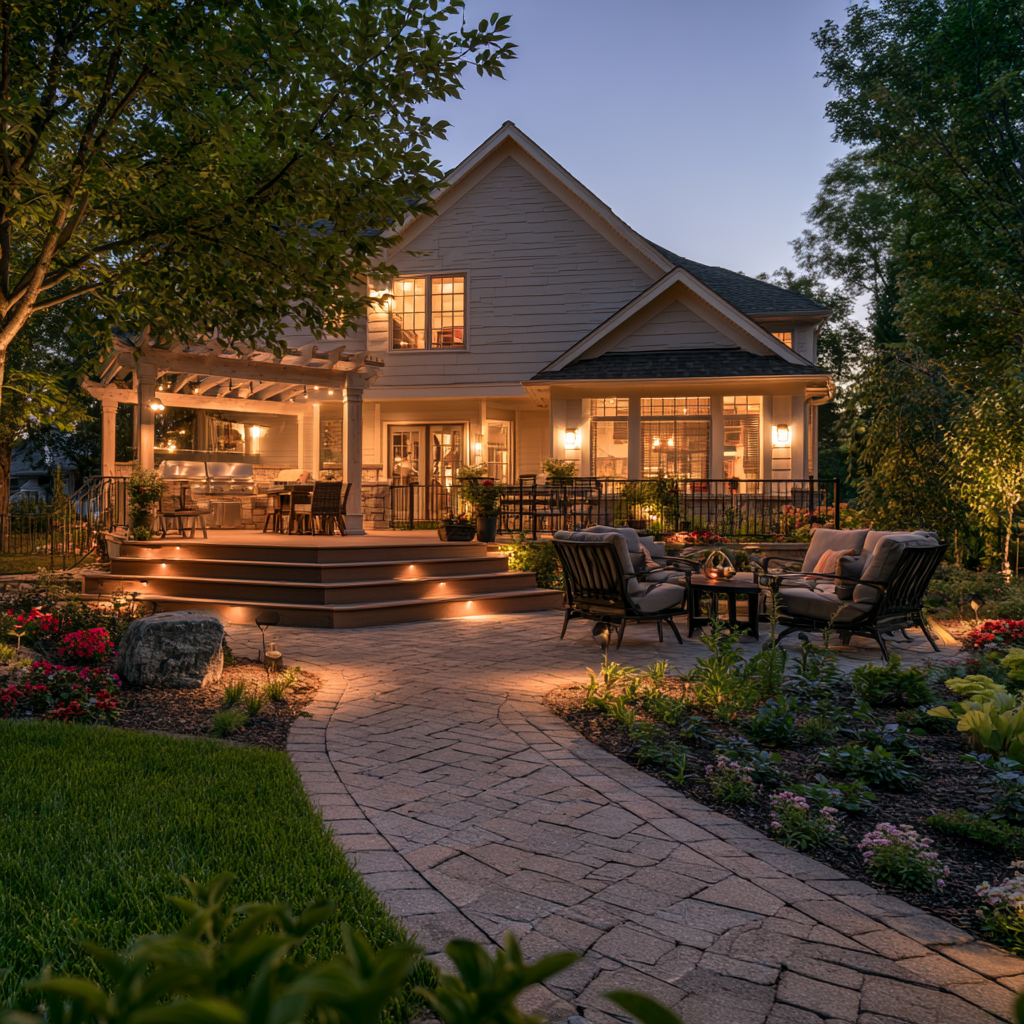
Deck lights can be incorporated into stair risers, posts, railings, and surrounding structures.
They’re particularly useful for highlighting elevation changes without flooding the entire deck with bright overhead light.
Wall and Sconce Lighting
Wall-mounted fixtures work well around doors, garages, covered patios, and outdoor kitchens. They provide functional illumination while also becoming part of the home’s architecture.
String and Decorative Lighting
String lights, lanterns, pendants, and chandeliers provide more atmosphere than landscape illumination.
They’re especially effective above dining areas, beneath pergolas, or around outdoor living rooms.
Think of them as the decorative layer that complements your primary lighting system.
Solar vs. Low-Voltage vs. Line-Voltage
The way your lights receive power is another major purchasing decision.
Solar Lighting
Solar fixtures are usually the easiest option to install because they don’t require electrical wiring. They’re excellent for homeowners looking for inexpensive pathway or decorative lighting.
However, performance depends on the amount of sunlight the solar panel receives, battery capacity, weather, and fixture quality. That makes solar lighting better suited to supplemental and decorative applications than areas where dependable illumination is critical.
Low-Voltage Lighting
Low-voltage systems are extremely popular for residential landscape lighting.
A transformer reduces household electricity to a lower voltage—commonly 12 volts—which is then distributed to fixtures around the property.
These systems are well suited to pathways, gardens, decks, trees, and architectural lighting. They also allow homeowners to build a more comprehensive lighting plan using multiple fixture types.
Line-Voltage Lighting
Some exterior fixtures operate directly from standard household electrical service. These are common for wall sconces, floodlights, security lighting, and certain architectural applications.
Because line-voltage installations involve household electrical circuits, professional installation may be appropriate or required depending on the project and local electrical codes.
Choose LED Whenever It Makes Sense
For most homeowners purchasing a new outdoor lighting system today, LED should be near the top of the list.
LED technology combines high efficiency with long service life and is available across virtually every outdoor fixture category. When comparing products, don’t focus only on wattage. Pay attention to lumens, which describe how much visible light the fixture produces.
More light isn’t automatically better.
Overlighting can create glare and wash out the atmosphere you’re trying to build. DarkSky recommends using the lowest practical light level and directing light specifically toward its intended target.
Pay Attention to Color Temperature
Color temperature is measured in Kelvin (K) and determines how warm or cool the light appears.
For outdoor living areas, warmer lighting often creates the most inviting environment. As a useful reference, DarkSky describes roughly 2700K–3000K as warm white, while 4000K and above appears noticeably cooler or bluer.
A warm color temperature works particularly well around:
- Patios and decks
- Outdoor dining areas
- Fire features
- Pergolas
- Landscape beds
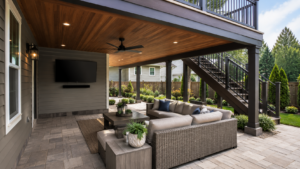
- Finished under-deck spaces
Cooler light can work in certain functional applications, but filling a backyard with bright, blue-white lighting can make it feel more like a commercial parking area than a relaxing outdoor room.
Check the Weather Rating
This is one of the most important specifications to check before purchasing.
A fixture being labeled “outdoor” doesn’t necessarily mean it’s appropriate for every exterior location.
UL guidance distinguishes between damp locations, which may experience condensation or moisture in partially protected areas, and wet locations, where water can drip, splash, or flow directly against electrical equipment. Fixtures installed in wet locations should specifically be rated for wet-location use.
For example, a fixture beneath a deeply covered patio may experience very different exposure than a landscape light sitting directly in a garden bed.
Always match the fixture’s rating to its installation environment.
Consider Smart Controls
You don’t necessarily need smart lighting, but controls can make a system considerably more useful.
Options range from simple photocells and timers to app-controlled transformers, motion sensors, dimmers, and complete smart-home systems.
You might program landscape lights to turn on at sunset, dim later in the evening, and shut off automatically overnight.
DarkSky specifically recommends controls such as timers, dimmers, and motion detectors so outdoor lighting operates only when it’s useful.
For larger properties, consider creating separate zones. The patio, landscape, pathways, and outdoor kitchen don’t always need to operate at the same time or brightness.
Think About Your Budget as a System
Instead of spending your entire budget on one impressive fixture, prioritize the areas that make the biggest difference.
For a budget-friendly project, consider solar path lights, LED string lights, lanterns, and a few carefully positioned accent fixtures.
A mid-range project might incorporate a low-voltage transformer with dedicated path lights, uplights, deck lighting, and automated controls.
A premium installation can combine architectural lighting, multiple landscape zones, recessed deck or patio lighting, smart controls, integrated outdoor kitchen lighting, and professionally designed fixture placement.
The goal isn’t to install as many lights as possible. It’s to create a balanced system in which every fixture has a reason to be there.
Don’t Forget What the Fixtures Look Like During the Day
Outdoor lights spend roughly half their lives turned off.
That means appearance matters.
Look at fixture materials and finishes alongside your home’s architecture, deck railings, furniture, hardware, and landscaping. Black and dark bronze fixtures often disappear naturally into landscapes, while architectural sconces and pendants can intentionally become design features.
Also consider long-term durability. Exterior fixtures face moisture, temperature changes, UV exposure, dirt, landscaping chemicals, and sometimes snow or salt. Spending more on well-constructed fixtures may make sense in demanding environments.
Should You DIY or Hire a Professional?
Simple solar and plug-in lighting projects are accessible to most homeowners.
Low-voltage landscape lighting can also be DIY-friendly for people comfortable planning and installing a system.
More complex projects—particularly those involving line-voltage electricity, extensive wiring, structural modifications, or sophisticated controls—may warrant a licensed electrician or professional lighting designer.
Professional design can also be worthwhile on larger properties where beam angles, fixture placement, brightness, glare, and multiple lighting zones become more complicated.
The Outleven Outdoor Lighting Buying Checklist
Before purchasing, make sure you can answer these questions:
- What is each light supposed to accomplish?
- Where will each fixture be installed?
- Is it appropriately rated for that environment?
- Is the brightness appropriate for the application?
- What color temperature do I want?
- Solar, low-voltage, or line-voltage?
- Do I want timers, dimming, motion detection, or smart controls?
- Can the system be expanded later?
- Does the fixture complement the home during daylight?
- Can I install it safely myself, or should I hire a professional?
Buy the System, Not Just the Light
The biggest takeaway when shopping for outdoor lighting is simple: don’t evaluate fixtures individually. Think about the entire outdoor experience.
A pathway light might guide you toward the patio. Soft deck lighting helps define the seating area. Uplighting reveals trees beyond the patio. Warm string lights create atmosphere overhead, while task lighting keeps the grill functional.
Each fixture accomplishes something different, but together they create a cohesive space.
Start with what you need the light to do, choose appropriately rated fixtures, prioritize comfortable brightness and color temperature, and leave room for your system to evolve.
Good outdoor lighting shouldn’t make you notice how many lights you installed.
It should make you notice how much better your backyard feels.
Sources
- DarkSky International — Five Principles for Responsible Outdoor Lighting
- DarkSky International — Responsible Home Outdoor Lighting
- DarkSky International — Outdoor Lighting & Color Temperature Guidance
- UL Solutions — Environmental Location Markings for Luminaires
Outdoor Heaters 101: A Beginner’s Guide to Choosing the Right Heating Solution for Your Outdoor Space
This beginner’s guide breaks down the most common outdoor heating options, including propane, electric infrared, and natural gas heaters. Learn how each type works, where it performs best, and what to consider when planning for your patio, deck, or outdoor living space.