A patio can have comfortable furniture and a beautiful view yet still feel too exposed to enjoy. Afternoon sun, glare, and nearby neighbors can all affect how often you use your outdoor space.
Outdoor curtains, blinds, and shades offer different ways to create a more comfortable setting. The right choice depends on what you want most: privacy, sun control, an open view, or a softer design.
Outdoor curtains work well for flexible privacy and a relaxed outdoor-room feel. Outdoor roller shades suit spaces where adjustable sun and glare control are the priority. Products sold as outdoor blinds vary, so compare their construction and outdoor rating rather than relying on the name alone.
What Is the Difference Between Outdoor Curtains, Blinds, and Shades?
Outdoor curtains
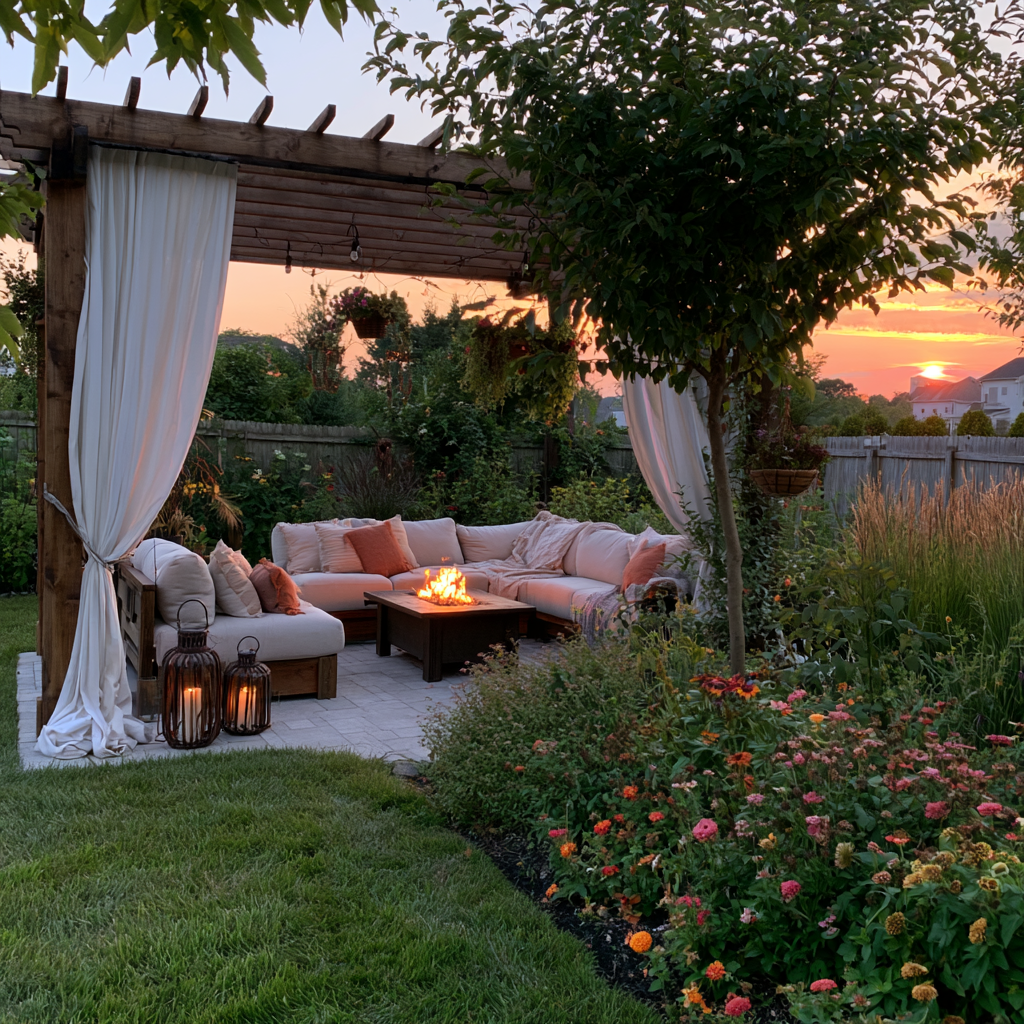
Outdoor curtains are fabric panels that hang from a rod or track and move horizontally. You can draw them across an opening, leave them partially closed, or gather them beside a post.
Their appearance ranges from lightweight sheers to heavier privacy panels. As Sunbrella explains in its outdoor curtain guide, fabric choice changes the balance between an airy appearance and greater privacy or protection from the sun.
Curtains are a practical design choice when you want to frame a seating area or make a covered patio feel more like an extension of your home.
Outdoor blinds
The term “outdoor blinds” can describe several products, including roll-up woven coverings and exterior roller shades. It does not always mean adjustable slats like those found on indoor window blinds.
Before buying, check how the product opens, what material it uses, and whether the manufacturer approves it for your exposure conditions.
Outdoor shades
Outdoor roller shades generally lower vertically across an opening and roll up when you want an unobstructed view. Solar shade fabrics filter sunlight rather than necessarily blocking it completely.
Phifer’s exterior shading fabrics are designed for applications including manual and motorized shades on patios, porches, and pergolas. Performance depends on the specific fabric and complete shade system.
Which Option Provides Better Privacy?
For privacy, focus first on fabric opacity and coverage.
A sheer curtain may soften the view without concealing the people behind it. A more opaque panel can provide stronger visual separation, but gaps between panels and around the edges still matter.
Solar shades require a different consideration: daytime privacy does not guarantee nighttime privacy. According to Phifer’s privacy guidance, visibility depends on fabric openness, color, and the difference in lighting on either side. When your patio is brightly lit after dark, people outside may be able to see through a mesh shade.
If evening privacy is your main goal, ask for fabric samples and evaluate them under conditions similar to your patio lighting. Look for an opaque outdoor-rated material, and plan enough coverage to minimize sightlines around the edges.
Which Is Better for Sun and Glare?
Outdoor solar shades offer a useful way to compare sun-control performance because manufacturers often provide specifications for the fabric.
One important measure is the openness factor, which describes how open the weave is. Phifer explains that tighter meshes generally block more heat and light, while more open fabrics preserve better outward visibility. Openness is not, by itself, a complete measure of UV protection or cooling performance.
Outdoor curtains can also intercept direct sunlight, depending on the material and placement. However, do not assume that every curtain provides the same UV protection or temperature benefit.
For either option, watch where sunlight enters during the hours you actually use the space. A shade placed across the west-facing opening may be more useful for late-afternoon dining than coverings installed evenly around every side.
Compare the Everyday Experience
| Consideration | Outdoor curtains | Outdoor roller shades or roll-up blinds |
| Appearance | Soft fabric, folds, and a layered look | A flatter, more structured appearance |
| Operation | Slide sideways and gather at the edges | Raise and lower vertically |
| Privacy | Depends on opacity, overlap, and coverage | Depends on material, openness, lighting, and edge gaps |
| Sun control | Depends on fabric and placement | Solar fabrics may offer published performance specifications |
| Open view | Panels remain gathered beside the opening | Fabric rolls above the opening |
| Installation | Requires suitable rods or tracks and supports | Requires suitable brackets, mounting surfaces, and operating clearance |
Use this comparison as a starting point. The specifications of the individual product matter more than the category name.
What About Wind and Weather?
Neither curtains nor basic roller shades should be treated as a permanent weather barrier.
Loose curtain panels can move in a breeze. Tiebacks help gather panels when open, but they do not turn the curtains into a wind-rated enclosure.
Roller shades may include bottom restraints or other retention systems. Those features also have limits. For example, Coolaroo’s installation instructions tell owners to roll up the shade before strong storms to prevent damage. coolaroousa.com
For an exposed patio, ask about wind restrictions, approved mounting methods, and when the product must be retracted or removed. Do not assume water-resistant fabric makes the complete installation suitable for every weather condition.
Plan Installation Before Choosing a Style
Measure each opening and identify where the hardware will attach. Account for posts, railings, doors, furniture, and walking paths.
For curtains, leave room for panels to gather without blocking access. For roller shades, check the space needed for brackets, the rolled fabric, and the operating mechanism.
Also consider how much coverage you need. A covering that fits neatly inside an opening may leave edge gaps, while a wider installation may require different mounting locations.
If the support structure or fastening method is uncertain, have an installer evaluate it before ordering.
Which Option Is Easier to Maintain?
Care requirements vary by material and construction.
Sunbrella’s drapery guidance permits mild soap and water for its drapery, along with specified fabric cleaners. That does not establish the correct method for every outdoor curtain.
For roller shades, Coolaroo recommends rinsing away dust and pollen or using mild soap and water for more stubborn spots. Its care instructions also call for drying the shade before rolling it up.
Choose a product whose cleaning and storage requirements fit your routine, and always follow its specific care instructions.
Choosing the Right Fit for Your Patio
Choose outdoor curtains when you want flexible coverage, fabric texture, and an inviting outdoor-room appearance. Choose outdoor solar shades when you want to adjust glare and sunlight while retaining some visibility through the material.
You can also combine them: a roller shade across the opening that receives strong afternoon sun and curtains around the seating area for privacy and style.
Start with the problem you want to solve, then compare materials, coverage, mounting requirements, and maintenance. That approach helps you select a covering that makes your patio more useful throughout the day.