-
An elevated deck creates valuable square footage underneath your home, but without a way to manage rainwater, that space can be difficult to use. Water passes through the gaps between deck boards, leaving the area below wet whenever it rains.
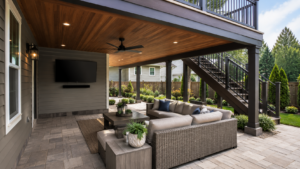
An under deck drainage system is designed to collect that water and direct it away from the area below, creating a drier space that can potentially be used for seating, entertaining, storage, lighting, fans, and other outdoor living features.
But not every drainage system works the same way.
Some systems are installed above the deck joists, while others attach below or between the joists. Some are best suited for new decks, while others make more sense when retrofitting an existing structure. There are also systems that double as the finished ceiling.
This buying guide compares several of the major options homeowners may encounter and explains what to consider before choosing an under deck drainage system.
First: Above-Joist vs. Below-Joist Drainage
Before comparing brands, understand the two primary approaches.
Above-Joist Systems
An above-joist system is installed over the deck framing but underneath the deck boards. Water passing through the decking enters troughs or membranes and is directed toward downspouts and gutters.
Because water is intercepted before reaching the framing, this approach can provide moisture protection for the tops and sides of the joists in addition to keeping the space below dry. Trex describes RainEscape as an over-the-joist system that captures water before it contacts the deck frame.
The catch? Installation is easiest before the decking goes down. On an existing deck, boards generally need to be removed to access the joists.
Below-Joist Systems
Below-joist systems allow rain to pass through the decking and over the framing before collecting it underneath.
Their biggest advantage is retrofit flexibility. Because installation happens from below, homeowners can often add one without removing an existing deck surface. Some below-joist systems also provide a finished ceiling at the same time.
The tradeoff is that the deck framing itself is still exposed to rainwater before the water reaches the drainage system.
Neither configuration is automatically right for every homeowner. Your existing deck and long-term plans should drive the decision.
- Trex RainEscape
Trex RainEscape is an above-joist system consisting of troughs, downspouts, flashing, butyl tape and a gutter system. Water is captured beneath the deck boards and routed away while the system shields the deck substructure from moisture. Trex currently backs RainEscape with a 25-year warranty.
Best suited for: New deck construction or major deck renovations where the decking will already be removed.
Advantages: Because the drainage layer sits above the framing, homeowners get both a dry area underneath and protection for the deck substructure. The bottom of the joists also remains available for a separate finished ceiling, recessed lighting, fans and other features.
Considerations: Retrofitting an existing deck can involve substantially more work because access from above is required.
- TimberTech DrySpace
TimberTech DrySpace takes a different approach. The solid extruded-vinyl system attaches beneath deck joists and channels water away from the space below. Importantly for existing homeowners, TimberTech says DrySpace can attach to new or existing deck joists.
DrySpace kits are designed around specific joist spacing and lengths. TimberTech lists options for 12-inch-on-center framing in 12-foot lengths and 16-inch-on-center framing in 12- and 16-foot lengths.
Best suited for: Existing decks where homeowners don’t want to remove their decking.
Advantages: Retrofit-friendly, relatively straightforward installation and a clean appearance from below. TimberTech also states that DIY installation is possible, although installation is easiest with two people.
Considerations: Because it’s installed underneath the framing, water reaches the joists before entering the drainage system. Deck dimensions and framing layout also need to fall within the system’s installation requirements; for example, TimberTech’s instructions state that DrySpace shouldn’t be spliced to create longer runs.
- Zip•UP UnderDeck
Zip•UP UnderDeck is particularly interesting for homeowners who want drainage and a finished ceiling in one system.
The PVC panels are installed below the deck and pitched toward a gutter. The visible panels create the finished ceiling while simultaneously directing water away. They can also be removed to provide access to utilities or for cleaning and maintenance.
Best suited for: Homeowners prioritizing the finished appearance of an under-deck patio or outdoor living room.
Advantages: Combines two project stages—water management and ceiling finish—into one system. Removable panels can be particularly useful if plumbing, electrical components or other utilities need to remain accessible.
Considerations: Correct pitch and flashing are critical. Zip•UP recommends a minimum drop of ½ inch for every 3 feet to move water toward the gutter.
- DEK Drain
DEK Drain offers something different: multiple drainage configurations.
Its TOPSIDE system installs above the joists before decking and is intended to protect the framing while creating dry space underneath. Its UNDERSIDE system attaches to the bottom of existing deck joists, while UNDERSIDE RECESSED fits into the joist bays so homeowners can later install a separate finished ceiling.
That gives homeowners options depending on the stage of their project.
Best suited for: Homeowners who want to choose between above-joist protection and retrofit installation within the same product family.
Advantages: TOPSIDE works well with new construction, while UNDERSIDE is designed specifically with existing decks in mind. DEK Drain says its panels use a 45-mil rubber membrane, and the company offers a transferable limited lifetime warranty.
Considerations: As with other systems, the installation method matters. An underside configuration doesn’t prevent the deck framing from initially getting wet, whereas TOPSIDE intercepts the water above it.
- Under Deck Oasis
Under Deck Oasis is another below-deck approach, but it uses an all-aluminum ceiling and drainage system.
Interlocking panels are installed beneath the deck structure and sloped to move water away while concealing the joists. This gives homeowners drainage and an architectural ceiling finish as part of the same project.
Best suited for: Existing decks where appearance and a finished metal ceiling are priorities.
Advantages: Combines drainage with a finished aluminum ceiling, eliminating the need to add a separate decorative ceiling beneath the drainage layer.
Considerations: Like other below-joist systems, rainwater passes through the deck surface and reaches the framing before being captured.
Under Deck Drainage Systems Compared
System
Configuration
New/Existing Deck
Framing Protected From Rain?
Finished Ceiling Included?
Trex RainEscape
Above joists
Best during new build/renovation
Yes
No
TimberTech DrySpace
Below joists
New or existing
No
Functions as exposed underside
Zip•UP UnderDeck
Below joists
New or existing
No
Yes
DEK Drain TOPSIDE
Above joists
New/renovated
Yes
No
DEK Drain UNDERSIDE
Below/between joists
Existing
No
Depends on configuration
Under Deck Oasis
Below joists
Existing/new
No
Yes
The important distinction is that keeping the area underneath dry and keeping the deck framing dry aren’t necessarily the same thing. Above-joist systems intercept water before it reaches the framing; below-joist systems collect it afterward.
What Should You Look for Before Buying?
Rather than choosing a system solely by price or brand, start with your deck.
Consider whether your deck is new or existing. If you’re already building a new deck, installing an above-joist system before the decking goes down may make sense. If you have a perfectly good existing deck you don’t want to dismantle, a below-joist retrofit can be considerably more practical.
Then think about your priorities: Do you want to protect the framing from rain, or is your main objective simply creating dry space? Do you want a finished ceiling? Will you install recessed lights or a ceiling fan? Do you need access to utilities? How complicated is your deck’s framing? What maintenance will the system require?
Finally, review manufacturer installation requirements and warranties carefully. Flashing, slope, gutter capacity and water discharge are fundamental parts of the system—not minor installation details.
Which Under Deck Drainage System Is Best?
There isn’t one answer for every deck.
For a new deck, above-joist systems such as Trex RainEscape or DEK Drain TOPSIDE have an important advantage: they manage water before it reaches the deck framing.
For an existing deck, TimberTech DrySpace and DEK Drain UNDERSIDE allow homeowners to add drainage from underneath without taking up the entire deck surface.
For homeowners primarily interested in creating a finished outdoor room, Zip•UP and Under Deck Oasis are worth considering because the drainage surface also serves as the visible ceiling.
The best system is ultimately the one that fits your deck’s construction, your budget and what you want the space underneath to become.
Final Thoughts
An under deck drainage system can turn one of the most overlooked parts of a backyard into usable outdoor space. Once protected from rainfall, the area beneath an elevated deck can become anything from dry storage to a complete outdoor living room with furniture, lighting, fans, entertainment and dining areas.
Before purchasing, pay particular attention to where the system sits in relation to the joists. That one decision influences installation, framing exposure, ceiling options and how easily the system can be added to an existing deck.
For homeowners researching their options, compare the systems based on your specific deck rather than searching for a universal “best” product. The right drainage system should solve today’s water-management problem while supporting whatever you eventually want to build underneath.
Sources
- Trex. Trex RainEscape® Under-Deck Drainage System. Trex RainEscape
- TimberTech. DrySpace™ Under-Deck Water Management System. TimberTech DrySpace
- DEK Drain. Under-Deck Drainage Systems. DEK Drain
- Zip-UP Ceiling & UnderDeck. Zip-UP UnderDeck System. Zip-UP UnderDeck
- Under Deck Oasis. How the Under Deck Oasis System Works. Under Deck Oasis

Outdoor Heaters 101: A Beginner’s Guide to Choosing the Right Heating Solution for Your Outdoor Space
This beginner’s guide breaks down the most common outdoor heating options, including propane, electric infrared, and natural gas heaters. Learn how each type works, where it performs best, and what to consider when planning for your patio, deck, or outdoor living space.